
Photographing a pavilion built for six days
Two pavilions at the Cannes Yachting Festival, shot across several editions and a method that transfers to any show in Europe.
Design studios that build across Europe want one thing from their photography: consistency. The same standard in Amsterdam as in Milan, in Cannes as in Düsseldorf. Images that sit together in a portfolio, hold up in an awards submission, and read as one body of work rather than five different ones.
That consistency comes from method. Here is ours, worked out over several editions of the Cannes Yachting Festival — and it applies wherever the truck unloads.
A pavilion is a building with a six-day life
It has a structure, a circulation plan, a materials palette and a lighting design. What makes it singular is its lifespan: six days, then it goes back into a truck.
That gives the photography unusual weight. Once the pavilion is down, the images are what remains. They become the studio’s portfolio, the reference it puts in front of the next client, and the record the brand keeps. There is no second visit and no better weather next week. Next year is a different building.
We have worked with Volvo Penta at the Cannes Yachting Festival since 2018, and with Yanmar since 2024. The images below are from earlier editions.
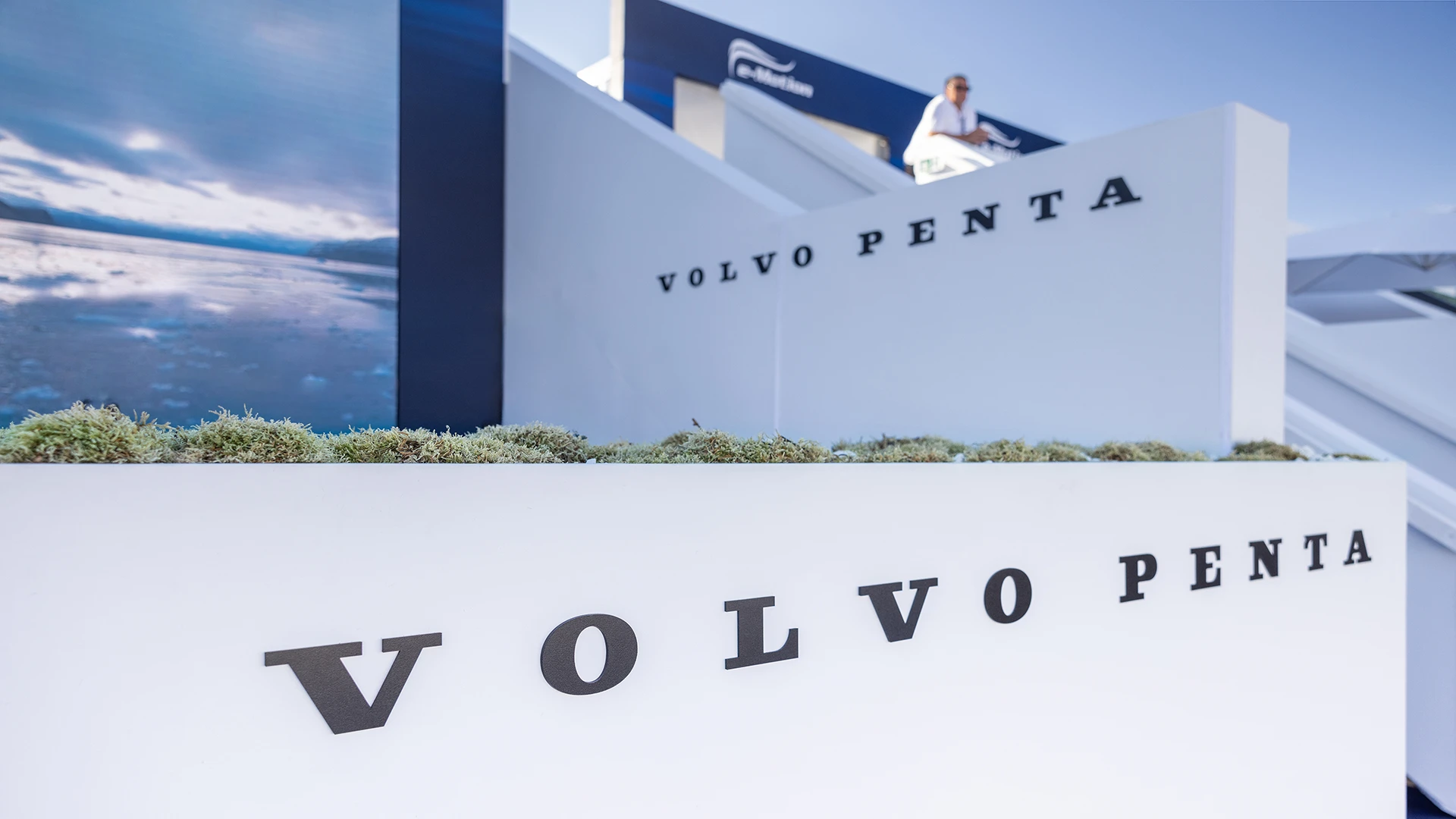
Volvo Penta, Cannes Yachting Festival 2024. Design: Carré 13
The build changes every year. So do the constraints.
Both pavilions are rethought for each edition. New volumes, new materials, new constraints. Nothing is reused from one year to the next — except the setting we work in.
That setting is consistent: the same September light on the same waterfront, the same sun angles at the same hours, the same mix of natural and artificial sources, the same interior volumes, the same six-day window. That is a real advantage. A method proven in 2018 still holds in 2026, even though the building is entirely new — and it holds just as well in another city, because a show build imposes comparable conditions everywhere.
Which is why the method is worth writing down. Each show then starts from established craft, and the attention goes where it belongs: on what makes this particular project distinctive.
Shoot just after the doors open, not before
The usual advice is to shoot before the show opens. On an outdoor site, it does not hold.
The Cannes Yachting Festival is built in the open, on the waterfront. What governs the image is not the absence of visitors but the angle of the sun.
Early morning light arrives low and sideways: it rakes across surfaces, separates volumes and brings out material. That angle stays favourable through the first hours of the day. By midday the sun is vertical and the light thins out.
So we work in the first hours after opening. The stands are still calm and the morning light is at its best. A pavilion with a few visitors in the background is a good photograph. Shot at noon under hard vertical sun, it is not.
Ambient light only
We work with the light that is there. No flash, no panels, no reflectors.
The pavilions open onto the sky and the sea, and adding light outdoors in Cannes in September means competing with the sun — a contest worth avoiding.
The stronger reason is that the lighting is part of the design. On the Yanmar pavilion, vertical oak battens cut daylight into bands and lay them across the seating, the tabletops and the interior detailing. That striping is part of the stand’s aesthetic. Flattening it with flash would remove precisely what most needs photographing.
In exchange, we accept a wide contrast range and take control of it in post. Which brings us to the most technical part of the work.
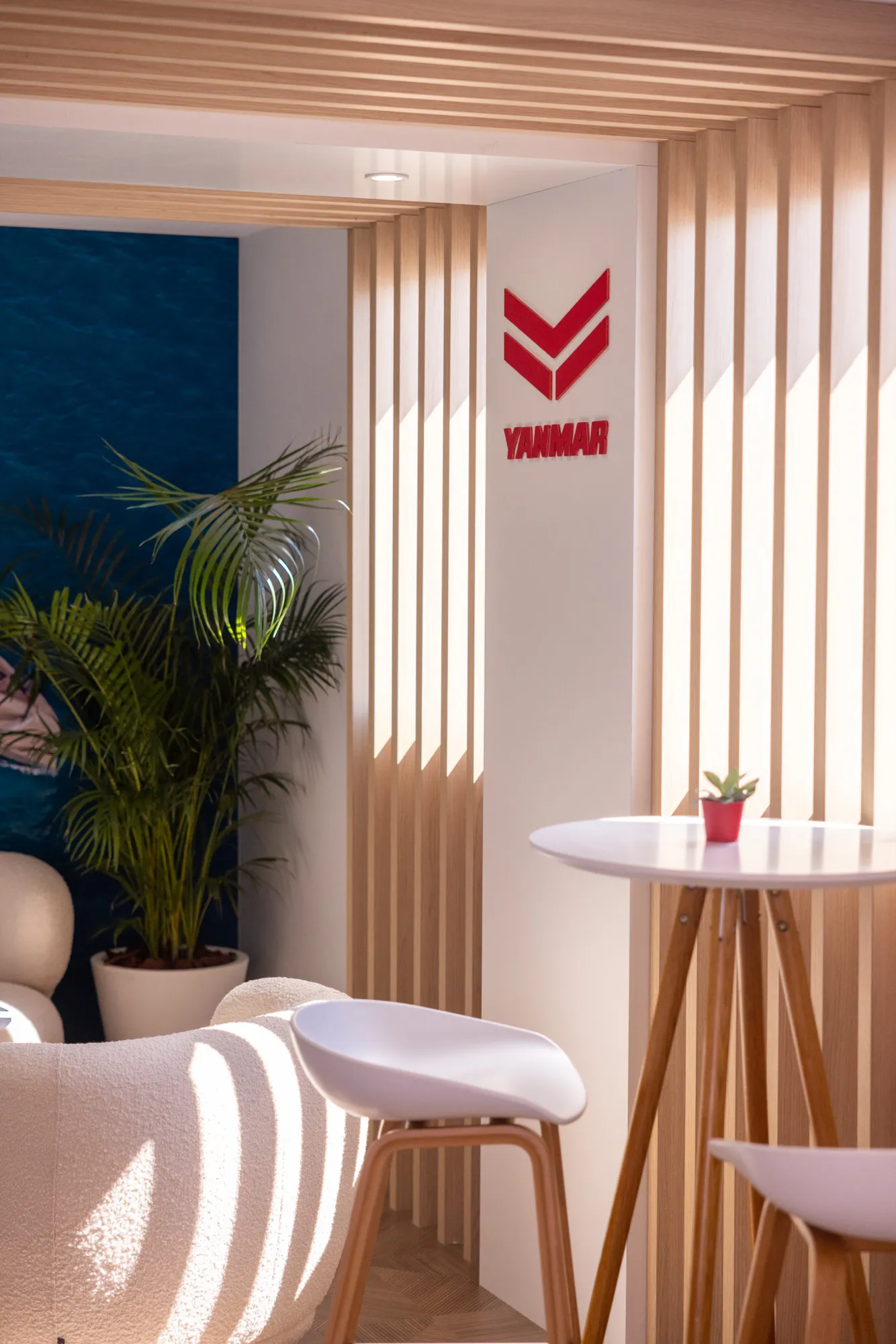
Yanmar, Cannes Yachting Festival 2025. Design : Marion Hummer. Project managed by ViGie Consulting.
Three colour temperatures in one frame
This is the technical point that rarely gets discussed, and it appears in almost every interior frame, every year, on both pavilions.
In a single shot you routinely have:
- warm LED downlights recessed in the ceiling;
- daylight through the open bays, climbing in temperature as the morning goes on;
- sometimes an LED video wall, casting magenta across every white surface facing it.
No single white balance resolves this. Set for the ceiling and the sea outside turns cyan. Set for daylight and the interior turns orange. Set for neither and everything is off.
The answer is not in the camera. It is the RAW file, a global balance set on the surface that matters most in that frame, then local corrections in Lightroom on the areas lit by the other sources. On an interior, that usually means taking magenta out of the ceiling while keeping the video wall saturated. That wall is a designed element: it should not merely stay blue, it should hold the exact blue chosen at the design stage.
White on white is about tint, not exposure
The Volvo Penta pavilion is built on white architecture: white claustras with triangulated cut-outs, white ceilings, pale floor, grey and off-white furniture, opening straight onto the marina.
Some photographers treat this as an exposure question. It is not. Exposure is straightforward: expose to the right, protect the highlights, done.
The decisive factor is tint. White surfaces carry no colour information to anchor a correction, so they take on whatever cast surrounds them: green from the awnings, magenta from the video wall, blue from the sky, and on exterior views, red bouncing off the show carpet onto the base of the façade. A slightly wrong tint and the whole pavilion reads dull, in a way people register without being able to name.
The fix is unglamorous: shoot a reference, and in post treat the magenta/green axis separately from warm/cool. It is the largest single quality gap between a professional interior photograph and a good amateur one.

Volvo Penta, Cannes Yachting Festival 2024. Design: Carré 13.
Keep the verticals straight
An exhibition pavilion is a small volume. There is rarely more than three or four metres of standing distance, so wide angle is unavoidable. We work with a 17–35 mm at f/5.6 on a Canon EOS R5.
Wide angle in a tight space forgives no tilt. A converging vertical reads instantly as an error, and it undermines exactly what the designer wants shown: that the volumes are square, the joinery is precise, the reveals are even.
Levelling the camera on site — and where appropriate working with a tilt-shift lens — is essential to control composition at the point of capture. Straightening in Lightroom then stays light, and image quality is preserved.
Yanmar, Cannes Yachting Festival 2025. Design : Marion Hummer. Project managed by ViGie Consulting.
Photograph the material, not only the volume
Wide shots show the plan. They do not show the craft, and craft is what a design studio sells.
On the Yanmar pavilion that means oak grain against the red logo, the chevron floor, fabric texture caught in raking light. Shot in the same light as the wide views, these details carry the quality of the work.
These are usually the images a studio ends up using most.
Deliver the next day
The show runs six days. We edit the same evening and deliver the finished gallery the following day, so the studio can use the images while the show is still running: posts, client follow-up, and the conversations on the last two days when decisions get made.
Next-day delivery is not a courtesy. On a six-day event it is the point.
The 2026 Cannes Yachting Festival opens on 8 September. New projects, same light, same six days. Close to 20 years in broadcast and commercial production, based on the French Riviera.
Photography : Benoit Galera || ByMyCom
Frequently asked
How long does it take to photograph a pavilion?
About an hour per pavilion for a complete set: exteriors, wide interiors, details. And under thirty minutes inside the pavilion itself, so the stand keeps working normally while we shoot. The constraint is the light, not the shot list.
Empty pavilion or with visitors?
As empty as possible for the architectural set - that is what the design studio needs. Frames with visitors are taken later in th
Are the images suitable for awards submissions?
Yes. Straight verticals, controlled tint and full-resolution raw processing are exactly what submission and publication require. Tell us in advance if a specific format or crop is needed.
Do you work elsewhere in Europe?
Yes. The method travels: a show build imposes the same conditions in Amsterdam, Barcelona or Frankfurt. Only the light changes, and the light is what we plan around.
Who owns the images?
Usage is agreed before the shoot. Design studios generally need portfolio, press and client-presentation rights, which is set up as standard practice.